-
Establish Broader
Perspective. Motivate Fundamental Innovation.
T-PIA Program-level International Accreditation FOR EMI PROGRAMS
Advancing Program Quality|STRENGTHENING Global Engagement
The TWAEA Program-level International Accreditationfor EMI Programs (T-PIA for EMI Programs), established by the Taiwan Assessment and Evaluation Association (TWAEA), supports higher education institutions in demonstrating and enhancing the quality and effectiveness of programs that use English as a medium of instruction (EMI) through rigorous international peer review.
T-PIA for EMI Programs examines program purpose and governance, curriculum design, English-medium teaching and assessment, student learning achievement, faculty capacity, academic and language support, resource provision, and quality assurance. More than a form of external recognition, it is a developmental process that helps programs reflect on their EMI purposes and practices, promote professional dialogue, and continuously enhance students’ ability to learn disciplinary content effectively through English.
- Download T-PIA Regulations
- Download T-PIA Accreditation Standards for EMI Programs
- Download the Applicant Institution Handbook for EMI Programs
- Download Application Materials (Word)—Application Form & Program Information Sheet
About T-PIA for EMI Programs
T-PIA for EMI Programs is an international accreditation framework for degree programs that use English as a principal medium of instruction. It promotes the quality of EMI education, student learning achievement, continuous quality enhancement, and global engagement.
Beginning with the program’s mission, educational goals, and rationale for adopting EMI, the accreditation systematically examines governance and public information; curriculum structure and learning outcomes; English-medium teaching and assessment; students’ understanding of disciplinary content and achievement of intended learning outcomes; faculty expertise and professional development; academic and language support for students; resources and infrastructure; and internal quality assurance and sustainable development.
The accreditation does not assess the English proficiency of individual students or faculty members in isolation. Rather, it evaluates whether the program provides coherent curriculum, effective teaching and assessment, and appropriate support mechanisms that enable students to learn disciplinary content through English, develop relevant academic and professional competencies, and achieve the intended learning outcomes.
The framework recognizes the diversity of national higher education systems, institutional missions, degree levels, disciplinary contexts, and approaches to EMI. Programs are evaluated in relation to their purposes, rationale for EMI, stage of development, and operating environment. Accreditation results therefore consider the coherence of program design, quality of implementation, student learning achievement, demonstrated effectiveness, and continuous improvement rather than relying on a single prescribed model or compliance checklist.
Who May Apply?
T-PIA for EMI Programs is open to Bachelor’s, Master’s, Doctoral, and other recognized degree programs offered by legally established higher education institutions that use English as a principal medium of instruction.
Eligible EMI programs may apply individually or as part of a phased institutional strategy for internationalization or EMI development. The standards are discipline-neutral and may be applied across the humanities, social sciences, natural sciences, engineering, business, health sciences, and interdisciplinary fields.
An applicant program must be duly established and recognized under the laws and regulations of its country. It should have a clearly defined rationale and objectives for EMI, established curriculum and teaching arrangements, and sufficient data and evidence to support self-assessment and external review.
Institutions are encouraged to consult TWAEA before applying to confirm the program’s eligibility, accreditation scope, readiness, and proposed schedule.
Accreditation Framework
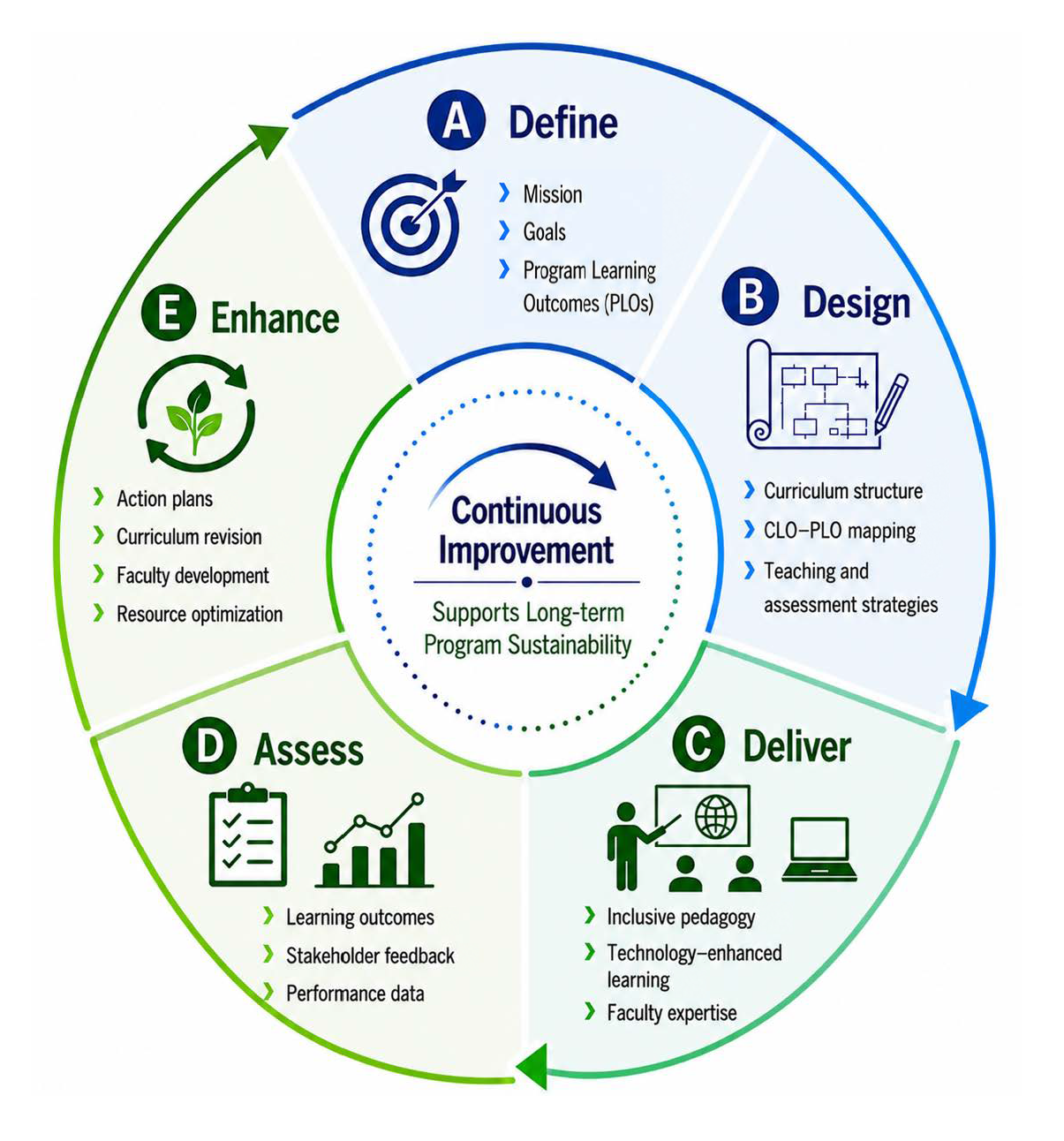
T-PIA for EMI Programs is built around a continuous enhancement cycle: Define – Design – Deliver – Assess – Enhance. Accreditation is therefore not treated as a one-time compliance exercise, but as an ongoing process connecting program mission, rationale for EMI, curriculum design, educational delivery, evaluation of outcomes, and improvement action.
Accreditation Process
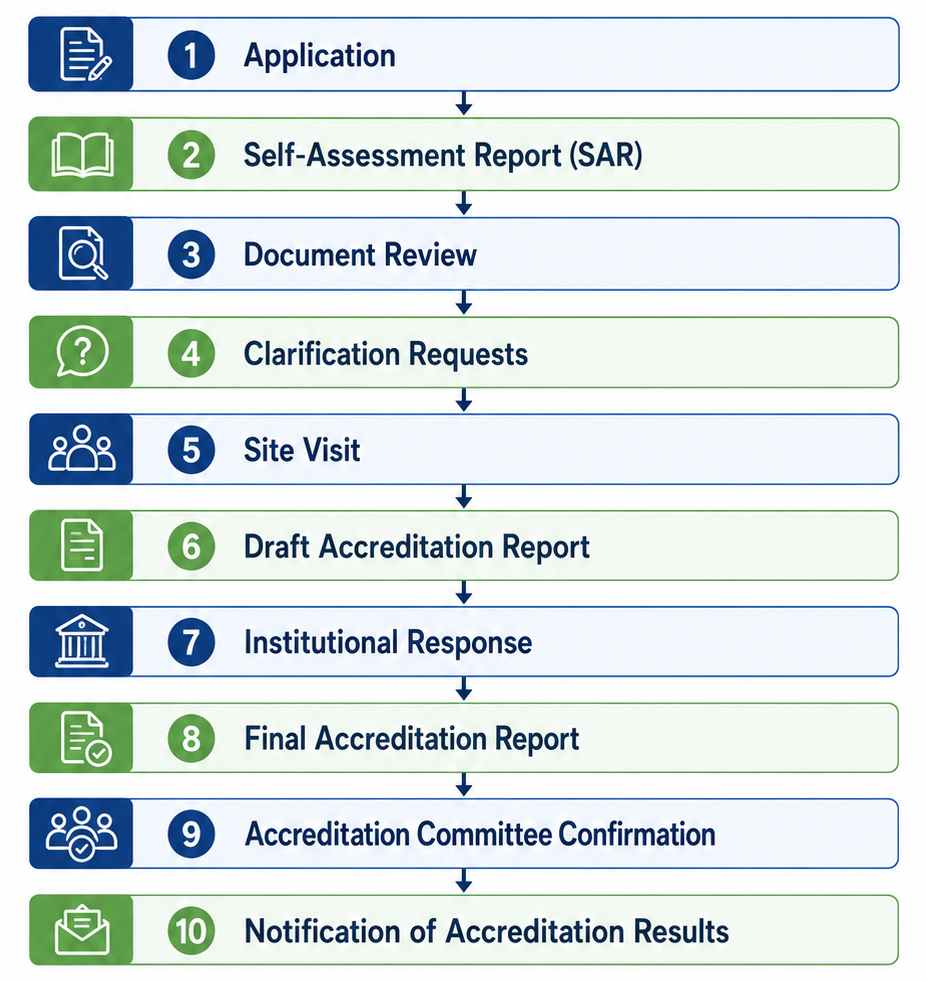
T-PIA for EMI Programs integrates self-assessment, international peer review, a site visit, institutional factual review, and independent deliberation. A typical accreditation cycle takes approximately 12 months from application to notification of the result. The actual schedule is developed jointly with the applicant institution and may vary according to program readiness, accreditation scope, institutional procedures, and site visit arrangements.
Accreditation Results and Validity
Results are classified as Accredited or Not Accredited. Programs granted Accredited status receive one of the following levels according to their overall performance, demonstrated quality, and achievement of the standards:
GOLD|valid for Five or six years
SILVER|valid for Three or Four years
BRONZE|valid for One or Two years
Accredited EMI programs receive a Certificate of Accreditation in English and in the official language of the applicant institution’s country. They may use the corresponding accreditation mark during the validity period in accordance with applicable regulations and guidelines.
Accreditation Fees
The accreditation fee covers reviewer honoraria and related administrative and accreditation arrangements. Travel, accommodation, local transportation, and meals associated with the site visit are handled separately by the applicant institution. Fees and payment terms are explained before application according to the accreditation scope and circumstances of each case.
Whether your institution is exploring accreditation, planning internally, or preparing to apply, TWAEA welcomes the opportunity to discuss the standards, preparation requirements, and a schedule suited to your program.